 Llandeilo Fawr
Church History
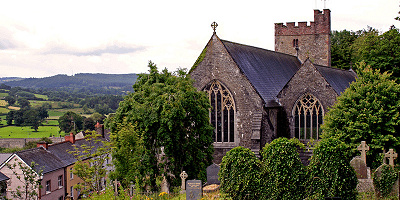
The church building which you see today was completed in 1850; the tower is late medieval. But the churchyard and the site on which the church stands have a much longer history.
Llandeilo's history as a known Christian centre dates from the sixth century. It was in the course of that century, probably towards its close, that one of the major Christian figures of Welsh history, St.Teilo, chose to make it his base and is buried here. Very little is known about Saint Teilo to whom the church is dedicated, but he seems to have travelled around Wales because there are several other churches dedicated to him in other places but as this was where he established his religious community it is known as Llandeilo Fawr. He, of course, gave the town its name.
The church building which you see today was completed in 1850; the tower is late medieval. But the churchyard and the site on which the church stands have a much longer history.
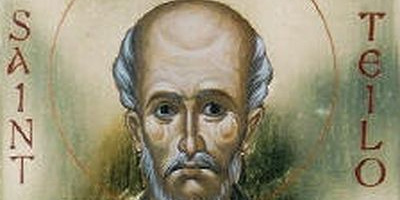
We know very little for certain about Teilo. The churches dedicated to him are spread around South Wales, and occur also in Brittany. He founded a community in Llandeilo Fawr.
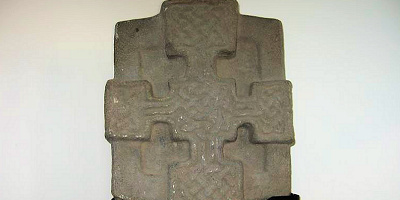
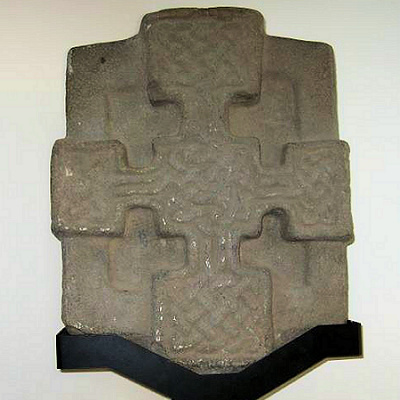
The cross which is displayed in St Teilo’s Church, Llandeilo Fawr was discovered when excavations took place during the building the current Church between 1848 - 1850.
The church building which you see today was completed in 1850; the tower is late medieval. But the churchyard and the site on which the church stands have a much longer history.
Llandeilo's history as a known Christian centre dates from the sixth century. It was in the course of that century, probably towards its close, that one of the major Christian figures of Welsh history, St.Teilo, chose to make it his base and is buried here. Very little is known about Saint Teilo to whom the church is dedicated, but he seems to have travelled around Wales because there are several other churches dedicated to him in other places but as this was where he established his religious community it is known as Llandeilo Fawr. He, of course, gave the town its name.
Llandeilo Fawr lost something of its ecclesiastical importance between 900 and 1200AD. In the ninth century it was the seat of a bishop. By 1200 it was a parish church, but with a very extensive parish covering some 20,000 acres. Llandeilo Fawr was also a wealthy parish, but its revenues, together with the lands of the old Teilo community were transferred to the abbey of Talley in the twelfth century,
The church was rebuilt in 1848-50. The pre-1848 building was a late medieval structure of c.1400. The tower is the only surviving feature of that building above ground. The rebuilders of 1848 chose to use the existing medieval foundations, so that the ground plan of the present church reproduces that of the medieval building. The present building was designed by Edward Davies, an architect from Bath, and built under the supervision of George Gilbert Scott. It was designated as a Grade II listed building in 1966.
We know very little for certain about Teilo. The churches dedicated to him are spread around South Wales, and occur also in Brittany. This distribution of his cult makes it seem likely that he travelled over this area. Two Lives of St.Teilo were written in the twelfth century, and purport to give a lot of detail about the saint, but are an inextricable mixture of local legends (with a probable core of historical fact) and pure invention.
While there is almost nothing which we can know for certain about Teilo, probable facts about him are these: he travelled through South Wales and in Brittany; he made Llandeilo his centre (its site on or near a Roman road gave it good communications to east and west); he founded a community in Llandeilo Fawr; he was buried at Llandeilo. Llandaff later claimed to have his body, but as late as the thirteenth century, visitors to Llandeilo, including King Edward I, were shown Teilo's tomb in the church here.
One of the most celebrated legends about him tells how, on his death at Llandeilo, three churches claimed his body: Penally (his birthplace), Llandeilo Fawr (his chief church), and Llandaff. The clergy of the three churches prayed, then left the body in the church. In the morning, the body was found to have been miraculously triplicated, so that each church could have an authentic body to bury!
Teilo was"Archbishop" of Llandaff, born at Eccluis Gunniau (Penally) near Tenby Pembrokeshire; died at Llandilo Vawr (Llandeilo Fawr), Carmarthenshire, probably in 560, an old man. It is thought that his true name was Eliau or Eilliau; in Latin it usually appears as Teliarus, in Breton as Teliau, and in French as Télo. He was cousin to St. David and born of a good family in Penally, near Tenby. His father, whose name was probably Usyllt, may possibly be identified with St. Issell, the patron of the parish church of Saundersfoot. His sister Anaumed, or Anauved, married King Budic of Armorica (Brittany), and became the mother of St.Oudaceus, Teilo's successor.
The earliest extant biographies of the saint are late and uncritical. Educated under St. Dyfrig or Dubric, at Hentland, Herefordshire, and under St. Paul the Old or Paulinus at Whitland, Carmarthenshire, he subsequently ruled the monastic school at Llandaff, named after him Bangor Deilo.
The story of his visit to Palestine with Saints David and Padarn (or Paternus) about 518, and their consecration there as bishops by John III, Patriarch of Jerusalem, is not now generally credited; but it seems that about that date, when St. Dubric withdrew to Bardsey, St. Teilo succeeded him at Llandaff. In 547 the "yellow plague" began to ravage Wales, and shortly afterwards St. Teilo with many of his flock crossed to Armorica, where they were hospitably entertained by his friend St. Samson, Abbot and Bishop of Dol. It is thought that Teilo and Samson planted a grove of apple-bearing trees between Dol and Cai, where the apple groves are still known as the groves of Teilo and Samson and still bear fruit today. At Landaul in Brittany, Teilo is considered the patron saint of apple trees and the town of Saint-Thélo in Brittany bears his name.
After seven years and seven months Teilo returned to Wales, and is said to have been elected to the archiepiscopate vacant by the death of St. David, and to have transferred it from Menevia to Llandaff.
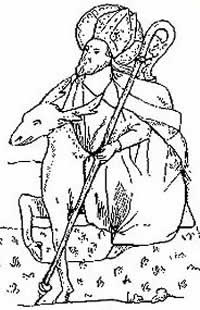
The story of the three bodies of the saint, which were discovered the day after his death, was probably invited to account for the fact that the churches at Llandaff, Llandilo Vawr, and Penally, all claimed to possess his body. Doubtless at his death his relics were widely distributed. Today they are venerated at Landeleau (Finistère), Plogonnac (Finistère), and Saint Télo (Côtes-du-Nord). Five parish churches in Brittany are dedicated to him (Landeleau, Leuhan, Montertelot, Plédéliac, and Saint Télo) as well as a chapel between Plogonnac and Locronan. The modern Catholic church at Tenby bears the names of "Holyrood and St. Teilo". The dedication of twelve churches in the present Anglican Diocese of St. David's, and of six in that of Llandaff, show they owe their origin to his zeal. It is argued that he has connection with six dedications in Cornwall and Devon. It is stated that he was formally canonized, but no date is given. He is not infrequently represented in Breton churches as riding on a stag (above). His festival is kept in Wales and at Saint Télo on 9 February but in Llandeilo Fawr on 20th February or the nearest Sunday.
The Celtic cross is a form of Christian cross featuring a nimbus or ring that emerged in Ireland, France and Great Britain in the Early Middle Ages. A type of ringed cross, it became widespread through its use in the stone high crosses erected across the islands, especially in regions evangelized by Irish missionaries, from the ninth through the 12th centuries.
The shape of the head of the cross is considered by many to be the defining feature of the Celtic Cross. The Celtic Cross' construction features a traditional cross accentuated with a circle around the intersection of the arms and stem. Structurally, the ring shape gives the cross strength, supporting the arms of the cross. Subject to many different interpretations, the Celtic Cross is said to be a representation of knowledge, strength and compassion to manage life's ups and downs.
Scholars have debated its exact origins, but it is related to earlier crosses featuring rings. The form gained new popularity during the Celtic Revival of the 19th century; the name "Celtic cross" is a convention dating from that time. The shape, usually decorated with interlace and other motifs from Insular art, became popular for funerary monuments and other uses.
The cross which is displayed in St Teilo’s Church, Llandeilo Fawr (left) was discovered when excavations took place during the building the current Church between 1848-1850. It dates from the 8th century and is unique in that as opposed to being surrounded by a ring, it is rectangular in shape. Reference is made to it in the National Museum of Wales, Cardiff.